
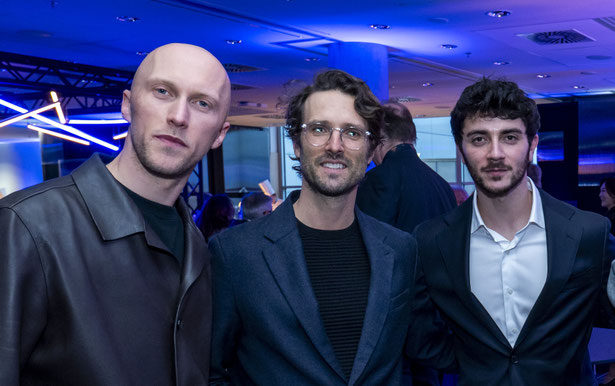

Skate Info Glace: As for Kévin Aymoz, he finished his season very strongly and showed that you can deliver a great performance despite a fall.
Fabrice: It’s just one fall out of seven jumping elements, and he got back up quickly. After that, everything is clean. That’s probably what Adam was missing this time. Kévin also fell on his second jump, but he managed to recover afterward. Adam, on the other hand, had a heavy fall, he pitched forward and got hurt. Kévin managed to move past it, and that’s great. That’s exactly what we expect from all our skaters. It’s a very good example. We’re happy. Worlds often go very well for him, and we know his programs are always interesting. On top of that, we secured three spots, which is great.
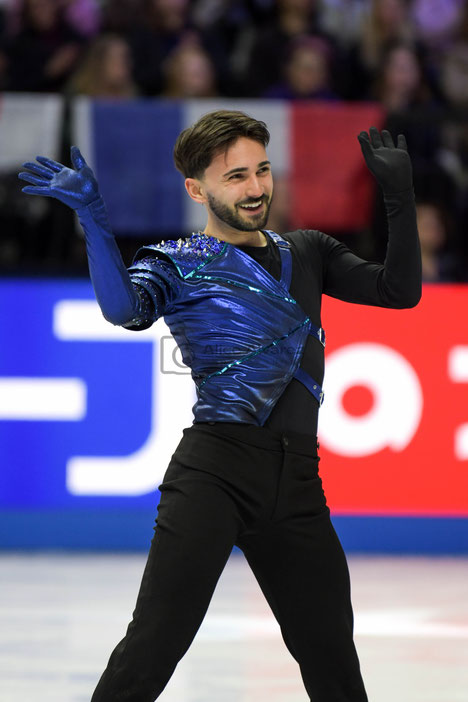
Skate Info Glace: What did you think of François Pitot’s first World Championships?
Fabrice: François definitely didn’t fall short. The quadruple Salchow in the free skate was magnificent. A combo was missing, but we’re very happy with his placement. Twentieth in his first World Championships, with qualification for the free skate, is very solid. He fell on the quad in the short program, but when you look at the level of the field, where even the last qualifiers for the free are landing two different quads, it confirms that you have to go for it. We had already been impressed by the level at the European Championships. You can’t hesitate anymore when it comes to attempting a quadruple Salchow. For François, this event was really about gaining experience. Landing a quadruple Salchow as the third element in the free skate, in front of 18,000 people, is important. We know he has potential. With consistent and serious work, results will come. He unlocked the quad at a major competition, now he needs to unlock the others, especially the toe loop. In competition, he is generally quite reliable. Artistically, there is still work to do and he will work with Benoît Richaud. We believe in him. Looking ahead to 2030 and 2034, there is something to build. He confirmed that here. But he shouldn’t wait for his place, he has to go and take it, even if it means beating the two “top” skaters.

Skate Info Glace: In ice dance, I imagine you’re satisfied?
Fabrice: Yes, it’s been a good season. A year ago, nothing was in place regarding Laurence Fournier Beaudry and Guillaume Cizeron. What has been achieved in such a short time is remarkable. There were many steps: administrative support, building the partnership, reworking the programs, changing the rhythm dance, constant adjustments… In many competitions, the rhythm dance scores were disappointing, but they stayed solid. Then they won the Olympic Games, with a program that wasn’t perfect but a fully deserved victory. Now there’s a question no one can answer: will they continue or not? Everyone thinks it would be a shame if they didn’t. But it’s their decision, they’re not 22 anymore. Of course, we would like them to continue. The public wants them to. They can still bring a lot. I think they can create something even stronger. Their free dance was built in the first month of their partnership, and it’s already excellent. But they haven’t yet explored more contemporary directions. It would be really interesting to see them go even further. But it’s their choice. And behind them, we also have many teams who deserve their place. We must not forget the next generation. We’ve seen it in other countries: when everything relies on one team, once they stop, there’s nothing left. So we also need to build what comes next. But of course, we would all be happy to see them continue, for the beauty of the sport.

Skate Info Glace: Evgeniia Lopareva and Geoffrey Brissaud had results slightly below last season, but the trajectory remains very promising.
Fabrice: Evgeniia and Geoffrey are really not far from the podium at these World Championships and at the European Championships. They are in the mix. Looking ahead to 2030, I see them on the podium. We are very happy with the season, because it started a bit difficult. They were a bit behind at the beginning, then they really put in a lot of work before the Grand Prix events. From that point on, things improved and progressed at every competition. They have their own style, and they need to keep going in that direction. We strongly believe in them.
Skate Info Glace: As you mentioned, there are also many teams behind them.
Fabrice: We have three spots for both the European and World Championships. We’ll see who earns them. There are Loïcia Demougeot and Théo Le Mercier, of course, but also many other teams. Some juniors will move up to the senior level at some point. For 2030, I’m unable to say which three teams it will be. We have an idea, of course, there are three teams currently ahead, but no one knows how things will evolve. Look at Gabriella Papadakis and Guillaume Cizeron: in their second senior season, no one could have predicted they would win titles so quickly. We knew they had potential, but the progression was very fast. Will juniors break through when they move up to seniors? I don’t know. A lot can happen. In any case, we hope it continues. We have strong training systems and good coaches. In ice dance, I think we are currently the strongest nation in the world.
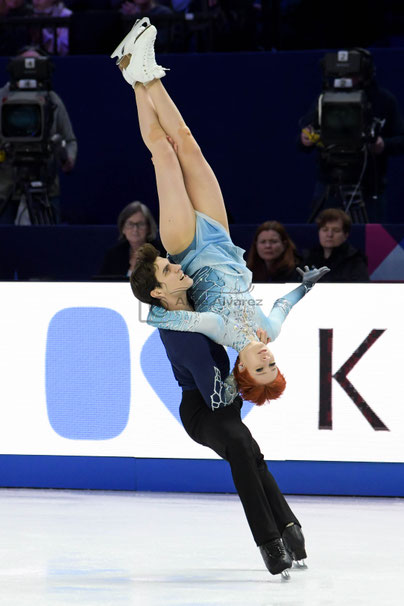
Skate Info Glace: Let’s move on to pairs. Camille Kovalev and Pavel Kovalev have announced they want to continue their careers.
Fabrice: I wish them the best. They have improved a lot this season. Last year, they didn’t qualify for the free skate, and now they delivered a strong short program. The free was more difficult. It’s good news if they want to continue. They are an experienced and reliable team, with good skating skills. We need them, of course. They are starting to land parallel triples, and that remains key. I also hope their ice time situation will be resolved, because that is a real issue.
Skate Info Glace: We are surprised that the top French pair, who just competed at the Olympic Games, faces such difficulties in accessing ice time.
Fabrice: They were able to buy ice time with our support and with the support of the "Maison régionale de la performance". But the situation remains complicated. That said, it’s not new, ice time hasn’t suddenly decreased. The rink is very beautiful, but the system doesn’t work well.
Skate Info Glace: Beyond their situation, how do you see the pairs field?
Fabrice: We want to build a strong team for 2030, especially with the Olympic team event in mind. We will also work with Aurélie Faula and Théo Belle, who have improved a lot this season. They have strong potential, with a solid repertoire of individual jumps. There are also other teams to follow. Clélia Liget-Latus and Alan Fisher have interesting strengths, with good triples. Meghan Wessenberg and Denys Strekalin progressed well at the end of the season. The first year of a partnership is often a building phase, but they already have two triple jumps and the Axel, so a solid base. They are developing their style. There is a wave of new pairs forming. It’s tough, some start and then stop. We need to explore as many options as possible, and we must not convert skaters too late.

Skate Info Glace: And what about the women’s field?
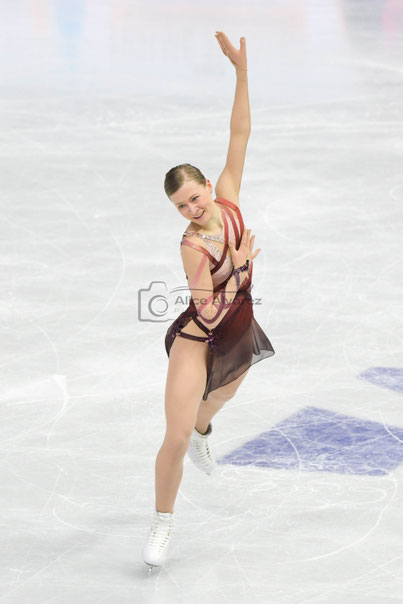
Fabrice: We still need to review the season with our skaters, especially Léa Serna and Lorine Schild. Lorine is also pursuing her studies, which are very important to her. I know she has major exams this summer. She reached a very strong peak in Angers, with 126 points in the free skate and 189 overall, which is a solid score. She had decent French Championships. After that, it was more difficult. At the Olympic Games, she delivered a good short program in the team event. She also skated a good short program here at Worlds. Qualifying for the Olympics was a major goal for her this season. Looking ahead, a team event medal in 2030 could be a great objective.
Skate Info Glace: The Olympic team event was an important goal. What is your assessment?
Fabrice: It was a real objective to take part in the team event. We didn’t fully reach the goal we had set, which was a top 5, or even a podium. It was very close. In a team event, everything comes down to very small margins. If, for example, we had Adam’s short program from here and Kévin’s free skate, it would have changed a lot! But we are really happy to have taken part in the event. A sixth-place finish is still a strong result.
Écrire commentaire