
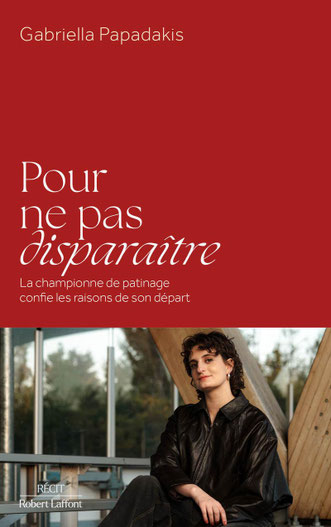
In her book Pour ne pas disparaître, Gabriella Papadakis looks back on her journey in ice dance, from her beginnings in Clermont-Ferrand to the end of her international career. A personal and painful book which lays bare the realities of a career as an elite athlete and breaks sharply with the idealized image long associated with this multi-medalled champion couple.
Growing up in skating and the formation of the partnership
Gabriella Papadakis describes a childhood largely shaped by skating. Her mother, a coach, organizes her daily life and sporting path. Very early on, skating becomes the priority, pushing school, music, and social life into the background.
“At that time, I often have the same dream. It wakes me up in a panic, my heart pounding. I am locked inside a glass box, embedded in the wall of my bedroom. Inside, there is a course, like a hamster maze. I have to run through it over and over, out of breath, never slowing down. My mother is there, outside, behind the glass. She shouts at me not to stop. Ever.”
Meeting Guillaume Cizeron is a key moment. The duo forms in a context specific to ice dance, where boys are few and often hold significant decision-making power. The book revisits the beginnings of the partnership, their rapid rise, and the construction of an increasingly unbalanced way of working.
Gabriella Papadakis describes a relationship that evolves, over the years, from a collaborative framework toward a more hierarchical organization. Sporting and artistic choices gradually become concentrated in the hands of her partner and the coaching staff, while she feels increasingly sidelined.
“The guy I skated with, who had been my best friend, was now treating me like his employee.”
Public image and internal dynamics
One of the book’s central themes is the gap between the couple’s public image and the reality of everyday life. In competition and in the media, the duo projects an image of great closeness. Outside that framework, Gabriella Papadakis describes a relationship marked by isolation and the difficulty of existing beyond the role assigned to her.
She explains how this image was maintained and used as a communication tool:
“Guillaume no longer hiding his homosexuality, all that was left for us was to play the card of unbreakable friendship: two children who found each other very young and stayed together no matter what, like soulmates. In public, we look like best friends: we joke, we laugh until we cry. However, if some form of complicity remains between us, it fades as soon as there is no one left to watch it.”
Montreal and the Ice Academy of Montreal
The move to Montreal and joining the Ice Academy of Montreal mark an important stage in their career. Gabriella Papadakis does not question the quality of the sporting work, but she nuances the idealized image of the center.
She describes a highly demanding, high-performance environment, but one that pays little attention to individual vulnerabilities and relational dynamics. Issues related to athletes’ appearance and presentation occupy a significant place in her account.
“Guillaume and the coaches even organize makeup lessons for me, presented as an ‘experience’ they are giving me.”
The return to competition of Tessa Virtue and Scott Moir, her idols, also based in Montreal, is presented as an additional source of pressure. The book also mentions, later on, a few moments of exchange with Scott Moir, marked by a level of listening and attentiveness that contrasts with the rest of her sporting daily life.
“Tessa Virtue and Scott Moir make their comeback, they return to competition. And they train in Montreal, with us. Shit. I don’t just have to be better than the competition, I also have to become better than my idols.”
“Guillaume is the only one to admit it. Sometimes he confides his anger to me: the coaches should never have accepted Tessa and Scott.”
Body and mental health
A significant part of the book is devoted to her relationship with her body. Gabriella Papadakis revisits the repeated comments about her physique and the thinness valued as a sporting quality.
“One day, a friend tells me he read an interview with Guillaume in which, when asked what my greatest quality was, he answered that it was my thinness.”
She also addresses defining episodes in her personal life: sexual violence suffered during adolescence, a contemplated stay in a psychiatric hospital, an abortion during a competition, and periods of depression.
“I collapse in tears. He asks me why I’m crying. I tell him I don’t know, that I’m just tired. He tells me I’m a world champion, that I should be happy. I stay silent, keep crying. I feel guilty for being sad, but I am inconsolable.”
The end of her career
Gabriella Papadakis describes a deterioration in the training atmosphere, suicidal thoughts, and a feeling of fear toward her partner. She also mentions, without dwelling on it, the new partnership formed by Guillaume Cizeron with Laurence Fournier-Beaudry, as well as her wish not to skate anymore with Nikolaj Soerensen while she was still training in Montreal.
The end of her career thus appears as a necessary outcome, more than a purely sporting decision.
“‘I’m afraid of you.’ I haven’t even admitted it to myself yet. Guillaume leaves the room, locks himself in the bathroom. I leave.”
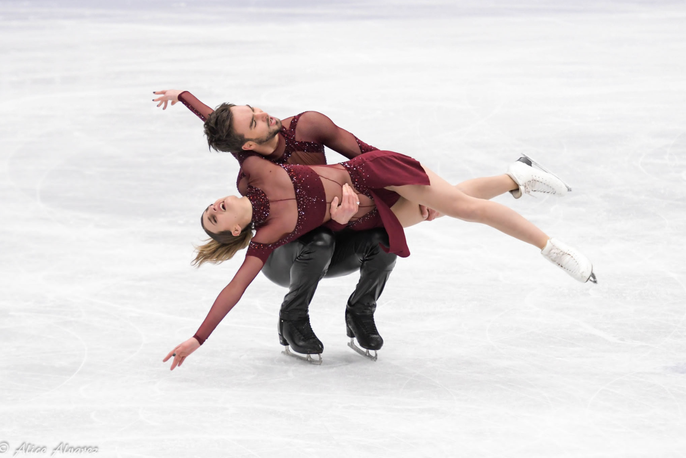
At the same time, Guillaume Cizeron shared the following statement:
“I would like to clarify my position in light of the recent accusations made against me, which have caused significant turmoil just days before the European Championships.
For more than 20 years, I have shown deep respect toward Gabriella Papadakis, whom I have always regarded as a true partner. Despite a gradual weakening of our bond over the years, our relationship, founded on equal collaboration both on a sporting and personal level, was marked by moments of success and mutual support. In the face of the smear campaign targeting me, I wish to express my incomprehension and my disagreement with the labels being attributed to me. These allegations arise at a particularly sensitive time, less than 15 days before the Olympic Games, thereby raising questions about the underlying intentions of this campaign. I also wish to denounce the content of the book "Pour ne pas disparaître", which contains false information, attributing to me, among other things, statements I have never made and which I consider serious.
In this context, I have chosen to entrust this matter to my lawyers and to formally notify all parties involved to immediately cease the dissemination of defamatory statements against me. I reserve the right to initiate any legal action necessary to protect my integrity.
I remain determined to focus on the upcoming competitive events and to defend my reputation with dignity and respect.”
Solène Mathieu - Skate Info Glace
Vous avez apprécié cet article ? N'hésitez pas à nous soutenir. Merci !
Écrire commentaire
Colin J M Wilson (samedi, 17 janvier 2026 00:34)
Will there be an English edition of the book and if so, when. Thanks
Gabriela TACHE (samedi, 17 janvier 2026 13:22)
I am interested in English edition. Where can I find it ? Thanks!
Renate (lundi, 19 janvier 2026 18:40)
I beleave her. Thes are her thoughts, her experiences, her feelings. At a special time it came to a burn out. In the world of figure scating women are in a more difficult position, This is well known. I think, Ciceron is here too squaemish. Tere are the same experiences of women in Russioan figure scating. Look at the Gymnastics- the same thing. If you want to achieve a gold medal, then it is necessairy to be in a verx demanding envoronment. So are the things everywere. All top athletes pay a price. Men are in firgure scating in Ice dance, pair scating...more dominant than women. It is not a bad character, so are the rules. I am convinced, that she did not mean any harm. Ciceron should be in my opinion more calm about this biography.